The Collections
Vintage Racing Posters
If automotive fine art is the gallery wing of car culture, vintage racing posters are its street art — commissioned to sell race tickets, pasted to fences and kiosks, and accidentally brilliant enough that museums now archive the survivors. Our catalog called them replicas of a golden age, and no phrase has ever fit better.
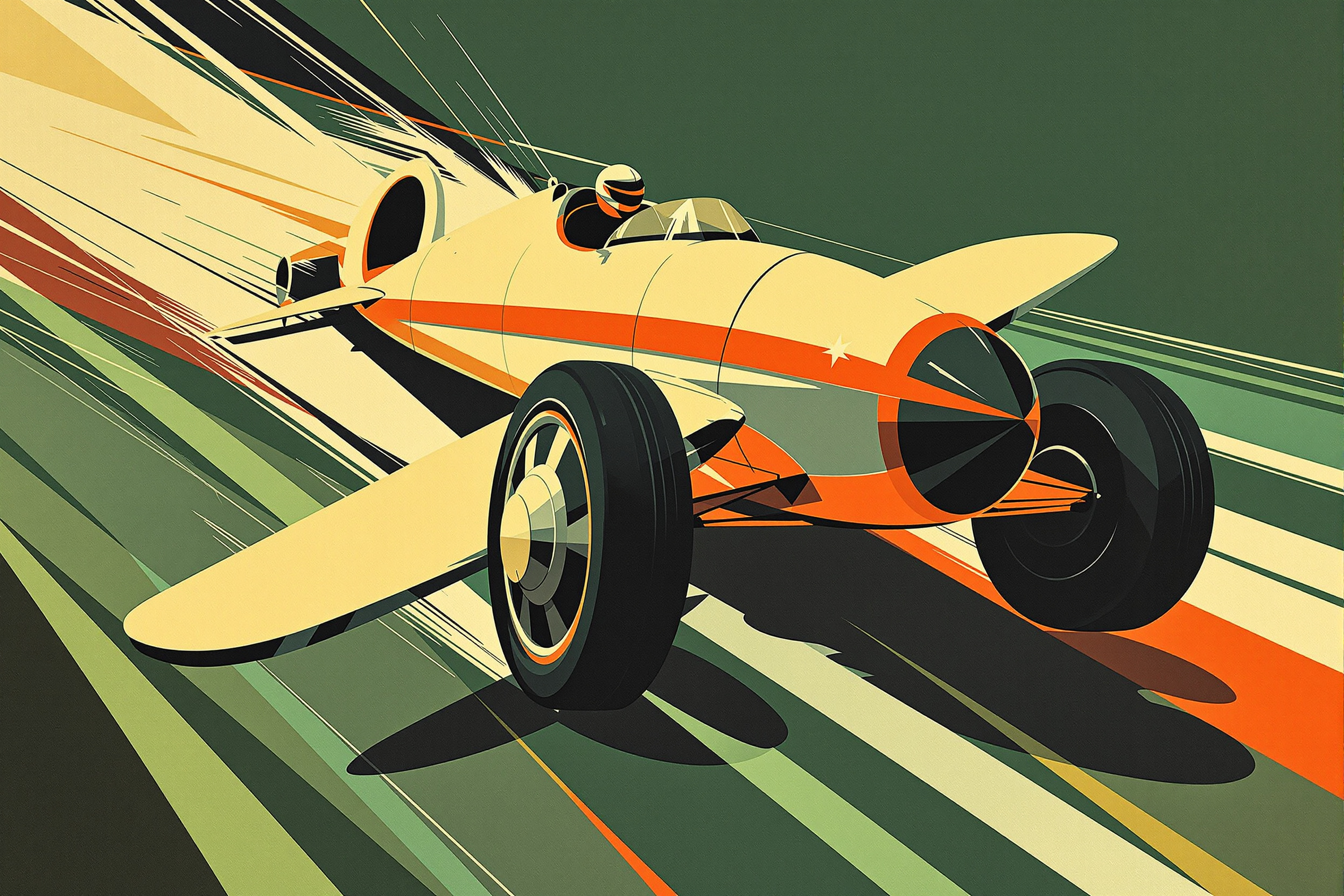
The Golden Age
From the mid-1920s to the end of the 1930s, European race organizers commissioned poster artists to make speed irresistible — and the artists, working at the height of the art deco movement, delivered some of the most striking graphic design ever printed. Grand Prix events on the Riviera, the great endurance races, hill climbs, land-speed attempts and aviation meets all got the treatment: streamlined machines slashing across the sheet on impossible diagonals, drivers reduced to goggles and resolve, typography that still looks fast standing still.
The Aesthetic, Decoded
- The diagonal composition — cars climb across the sheet at twenty degrees because horizontal machines look parked.
- Flat, saturated color — stone lithography laid down ink in bold, unmodulated fields: vermillion, deep green, cream and black doing the work of a thousand gradients.
- The low horizon — putting the viewer at hubcap height makes everything monumental.
- Speed abstraction — whip lines, dust plumes and stretched reflections, conventions invented for these posters and never improved upon.
Originals Versus Reproductions
Original stone-lithographed posters are scarce almost by definition — they were ephemera, printed for a weekend and discarded. Clean survivors trade at serious auction prices and are increasingly museum objects; the Library of Congress poster collections show what institutional preservation of this material looks like. For everyone else, museum-grade reproductions — faithful color, lithograph grain intact, heavyweight stock — deliver the entire visual experience for the price of a dinner. The full story of how we fell down this particular rabbit hole is in the journal: Automotive-Art erupts with classic racing posters.
Beyond the Race Track
Collectors who start with Grand Prix subjects soon discover the adjacent golden-age genres, printed by the same houses in the same glorious idiom: aviation meet posters (the original speed romance — our catalog carried a famous salon poster for years), motor show announcements, hill climb and rally bills, and the petroleum and tire advertising that put art deco machinery on every garage wall in Europe. These adjacent genres often cost meaningfully less than the marquee racing images while delivering identical visual wattage, and a mixed wall — one race, one rally, one aviation meet — reads richer than any single-subject run. The era was a style, not just a sport.
Living With Posters
Racing posters are the most forgiving automotive art to decorate with: graphic enough to anchor a room, period-flexible enough to hang beside modern furniture, and naturally at home in dens, garages, offices and stairwells — especially in series, where three or four posters of one era become a single architectural statement. Frame simply (thin black or natural wood), mat generously, and use UV glass; the flat inks that make these images sing are also the first casualties of sunlight. Then stand back and enjoy the only traffic that improves a hallway.
Want the historical context behind the events these posters advertised? Ninety years of racing archives are a click away.