Braking News · Vintage Posters
Automotive-Art.com Erupts with Classic Racing Posters — Seriously!
Our founder had just returned from a two-year international quest. His objective: locate a 100% high-caliber source for prints of the most exceptional racing posters from yesteryear. As of the end of 2015, the endeavor looked like a washed-up schooner impaled on thunderous boulders around Nantucket. A scene from the 16th century! Impaled. Immobile. Impatient. Some colleagues were even heard to snicker behind his back.
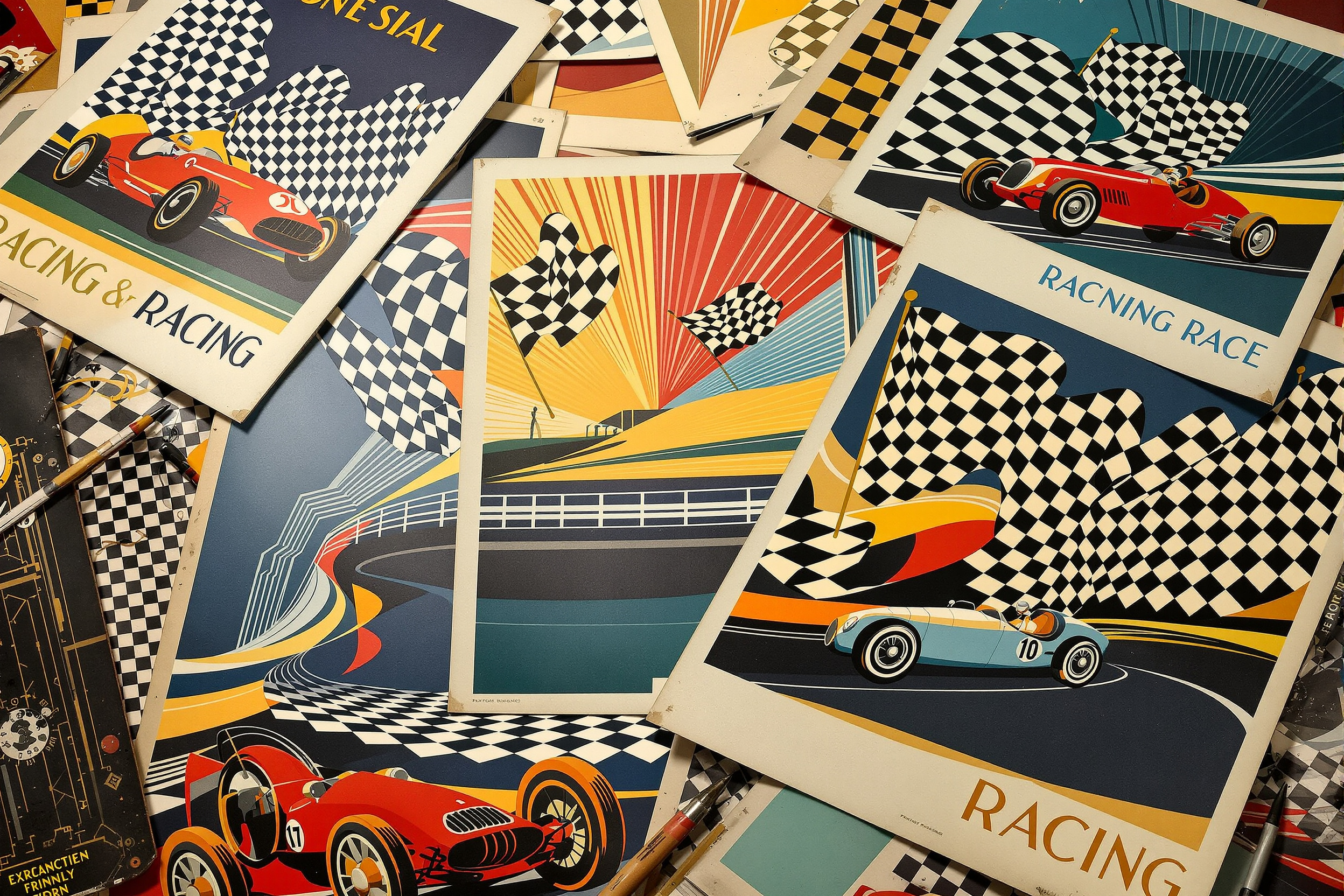
And then the breakthrough — a printer capable of reproducing the great Grand Prix posters with the color fidelity and paper quality they deserve. The snickering stopped. The walls of the gallery erupted with checkered flags, streamlined racers and art deco typography, and we have been evangelizing this corner of automotive art ever since.
Why Racing Posters Matter
Between roughly 1925 and 1939, European motor racing produced some of the most striking graphic art ever printed. Event organizers in Monaco, on the great road circuits, and at hill climbs and aviation meets commissioned poster artists to sell excitement to the public — and the artists delivered masterpieces of the art deco idiom: low horizons, screaming diagonals, machines reduced to pure velocity. Masters of the form like Géo Ham and Robert Falcucci defined how speed looks on paper, and their visual language still dominates motorsport graphics today.
Why Originals Are So Scarce
Posters were ephemera. They were pasted to walls and kiosks, rained on, painted over and thrown away — nobody in 1932 imagined collectors would one day pay the price of a decent car for a surviving example. Stone-lithographed originals in good condition are now museum objects and auction stars; the Library of Congress Prints & Photographs division preserves and digitizes poster art of this era precisely because so little survived in the wild.
What Makes a Reproduction Worth Hanging
- Source fidelity. The best reprints work from high-resolution captures of clean originals, preserving the lithograph grain rather than flattening it.
- Color discipline. The flat, saturated inks of stone lithography are the whole show; a muddy reprint misses the point entirely.
- Paper weight. A heavyweight matte stock hangs flat, takes framing well and reads as a print rather than a photocopy.
- Honest labeling. A good reproduction says it is one. Beware sellers blurring the line — original poster collecting is a serious market with serious prices.
Collecting Notes
A few practicalities from the gallery floor. Golden-age posters were printed large — commonly around 47 by 63 inches in the grand European formats — so measure your wall before you fall in love, and remember that quality reproductions are usually offered in friendlier sizes. For originals, linen backing (conservation mounting on canvas) is standard and accepted by collectors; amateur dry-mounting is not, and it destroys value. Watch for trimmed margins, retouched folds and over-bright restoration. And whether original or reproduction, frame with UV-filtering glazing: the saturated flat inks that make these designs sing are the first thing sunlight steals.
For the deeper story of the era these posters advertised, see our guide to free racing history archives — many digitized programs and photographs show these very posters pasted to period fencing, doing their original job.