Braking News · Fine Art
Are Delahayes the Most Beautiful Cars Imaginable?
Yes, probably. This much we know: the most brilliant coachworks operating in the grandest era of automobiles worked their magic on Delahaye chassis. You know the names — Figoni & Falaschi, Saoutchik, Franay, Chapron. The Delahayes appear right in front of you at the top concours events around the world, and they snap your breath away.
A Short History of Extravagance
Delahaye was no upstart — the French firm built its first automobile in 1894 and spent decades producing solid, respectable machinery. Then came the mid-1930s and the Type 135: a competition-bred chassis that won rallies and endurance races outright, and became the favorite canvas of the Parisian coachbuilding houses. Figoni & Falaschi’s teardrop coupes and cabriolets on the 135 chassis remain, for many, the high-water mark of automotive form: fenders like breaking waves, chrome sweeps that exist purely for joy, proportions closer to sculpture than transport. The even rarer V12 Type 165 took the formula further still. The marque faded after the war and closed its doors in 1954 — which only deepened the legend.
And the beauty had teeth. The 135 was a genuine competition machine: rally victories, podiums in the great French endurance races, and a famous 1937 triumph in the “million franc” speed challenge that pitted France’s best against the state-funded German teams. A 135M won the 24 Hours of Le Mans outright in 1938. This is why artists keep reaching for Delahayes: under the most extravagant bodywork of the era sat a racer’s chassis, and somehow you can see that tension in the standing car — a couture gown over an athlete.
Why Artists Can’t Resist Them
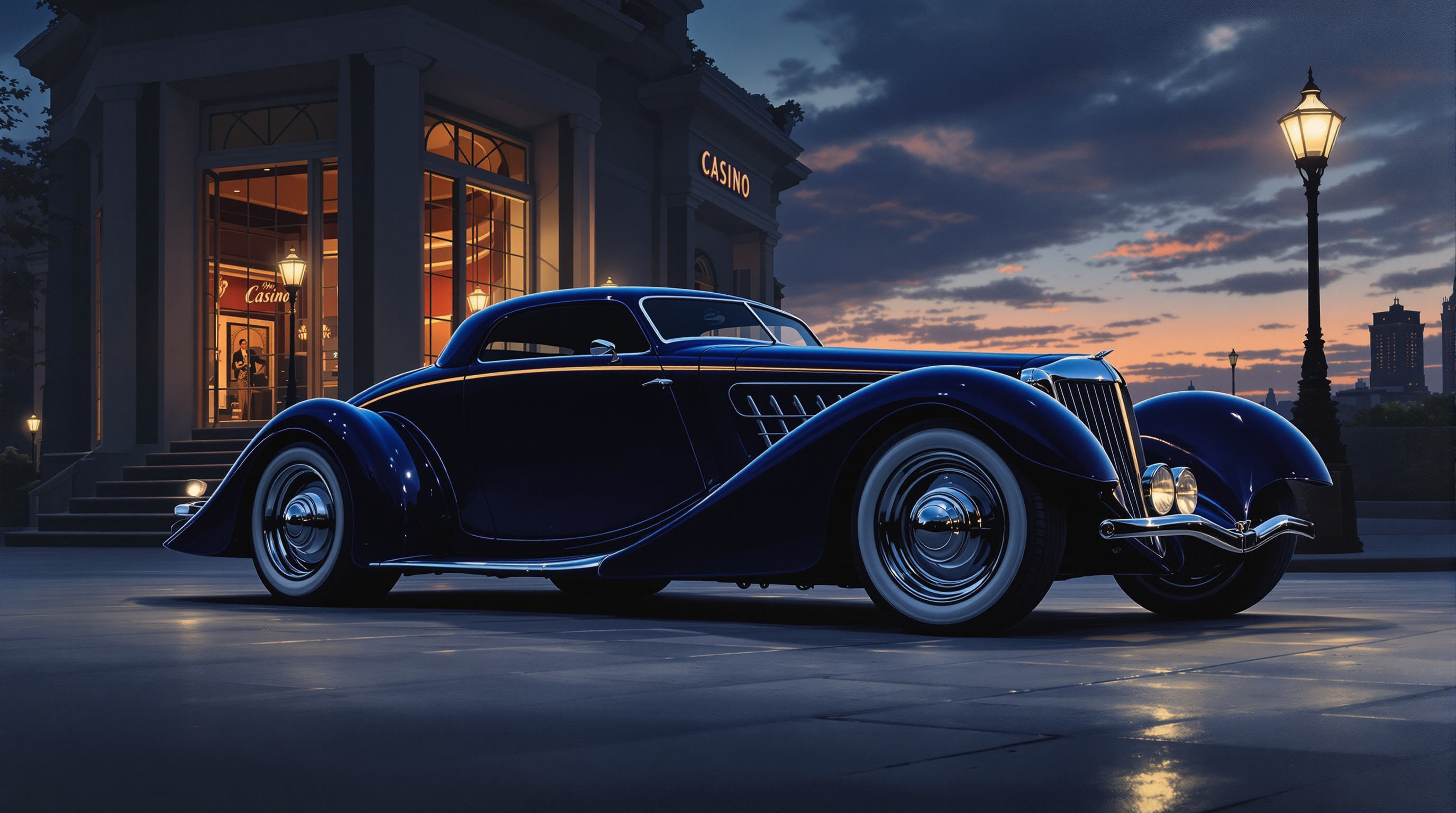
Automotive fine artists return to Delahayes generation after generation, and the reason is simple: these cars were already art, so painting them is a conversation rather than a translation. The finest painters refuse to freeze a Delahaye like a photograph from last summer’s golf-course exhibit. They stage it — in dramatic settings that capture the timeless rapture of the car.
One celebrated painter of the marque works theatrically, cinematically: a single canvas shares an entire story, the Delahaye staged in a context — twilight, lamplight, an elegant figure mid-stride — that makes you appreciate its beauty and drama even more. Another acclaimed artist goes the other way entirely, focusing on tight close-ups that reveal the mystique of the car: the way light pools in a fender’s curve, the reflections swimming in pre-war chrome. Sounds like romantic nonsense — until you stand in front of the work, and then how else would you describe it?
Where to Fall in Love Yourself
Surviving coachbuilt Delahayes live mostly in great collections and museums. The Petersen Automotive Museum in Los Angeles has displayed several of the most flamboyant examples; the research library at the Revs Institute can serve you period photographs of these cars when they were simply new, parked outside Parisian salons as if that were a normal thing a street could contain.
And when the real thing is out of reach — which, at recent auction prices, it is for nearly everyone — the fine art route is no consolation prize. A great Delahaye painting hangs in your den and reorganizes the whole room around itself, exactly as the car once reorganized every boulevard it entered.